Saturday, 19 June 2021

Even down on the ground, the cross has power

Vasistha means very rich. Its is said that Vasistha is also one of the greatest sages emanated by Brahma to eliminate the sorrow of the human existence. Though he was born a mere mortal, suffering grief and heartache, he one day asked Brahma, how to get rid of them? And Brahma replied: You are not the body and mind; you are infinite. You are not stuck; your true nature is unlimited. You are the one. Enlightened, he and his loyal wife Arundhati became rishis and protectors of Dharma.

Vasistha initiates King Rama and had Visvamitra as a pupil. In Yoga Vasistha, he tells the student Rama that self-knowledge alone leads to the end of all physical and psychic disturbances. In the Yoga Sutra 2.33-34, Patanjali advises, “Vitarka badhane pratipaksha bhavanam”: when troublesome thoughts (vitarka) afflict (badhane), cultivate (bhavanam) opposing thoughts (pratipaksha), ie change your perspective. This is what Vasistha taught Rama to do: change your perspective from suffering and limitation to the infinite bliss of the present moment. Some scholars say that Vasistha was the first teacher of Jnana Yoga or the yoga of knowledge.

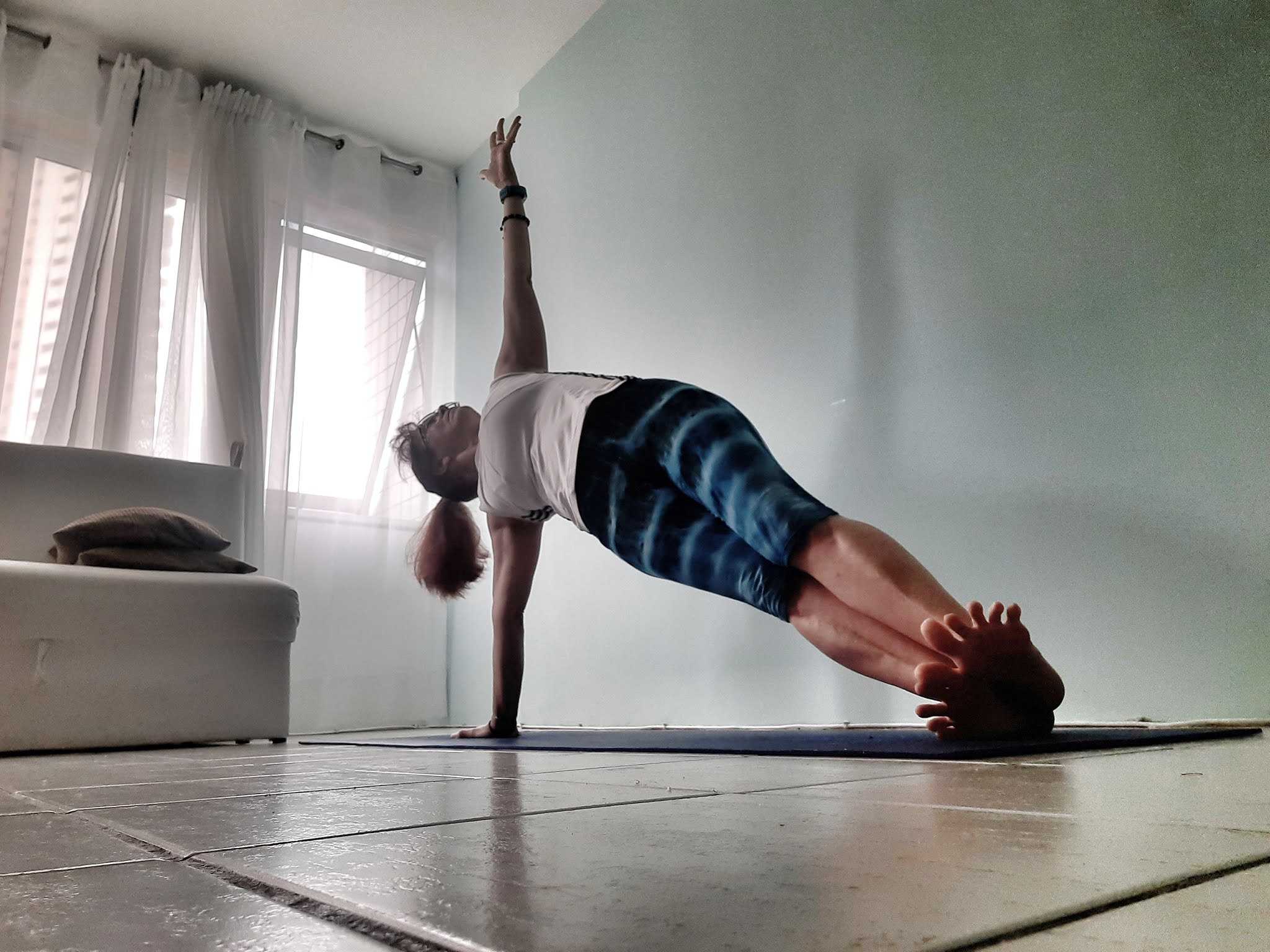
Classic Vasisthasana or side plank
Again, the postura Vasisthasana is modern and needs to be associated with the mythical Vasistha, who possessed all wealth and wisdom. And it is to this mythical seat that physical posture, which could be translated as the richest of all, must take us. Coined by B.K.S Iyengar as a sideboard with the outside leg raised, it promotes balance and strength at the same time. My personal feeling in carrying it out is that of a firm grounding in reality totally free to reach the heights of liberation, like a fallen cross that does not lose its power.


QUESTION FROM MY TEACHER CARLOS EDUARDO : 
Which bird represents our perishable nature and which represents our imperishable nature?

I see that Krauncha resembles the jivatma, wanting the liberate a perishable body, attacked by soul hunters. And I see Mayura as a being who goes beyond temporary identities, who has eyes that see from all points and, therefore, is able to see its true limitless nature.

Mesmo ao chao, a cruz tem poder

Vasistha significa riquíssimo. Diz que é também um dos maiores sábios emanados por Brahma para eliminar a tristeza da existência humana. Embora tenha nascido como um mero mortal, sofrendo tristeza e dissabores, ele um dia perguntou a Brahma, como fazer para se livrar delas? E Brahma respondeu: Você não é o corpo e a mente; você é infinito. Você não está preso; sua verdadeira natureza é ilimitada. Tu és aquele. Iluminado, ele e sua leal esposa Arundhati se tornam rishis seguidores e protetores do dharma.

Vasistha inicia o rei Rama e tem Visvamitra como aluno. No Yoga Vasistha, ele  diz ao aluno Rama que só o  autoconhecimento leva ao fim de todos os distúrbios físicos e psíquicos. No Yoga Sutra 2.33-34, Patanjali aconselha, “Vitarka badhane pratipaksha bhavanam”: quando pensamentos problemáticos (vitarka) afligem (badhane), cultive (bhavanam) pensamentos opostos (pratipaksha), ou seja, mude sua perspectiva. Isso é o que Vasistha ensinou Rama a fazer: mudar sua perspectiva do sofrimento e da limitação para a felicidade infinita do momento presente. Alguns estudiosos dizem que Vasistha  foi o primeiro professor de Jnana Yoga ou o yoga do conhecimento.

De novo, a postura Vasisthasana é moderna e precisa estar associada ao Vasistha mítico, que era dono de todas as riquezas e sabedoria. E eh a esse assento mítico que a postura física, que poderia ser traduzida como a mais rica de todas, deve nos levar. Cunhada por B. K. Iyengar como uma prancha lateral com a perna de fora levantada, promove ao mesmo tempo equilíbrio e força. Minha sensacao pessoal ao executa-la e a de um aterramento firme na realidade para alcancar as alturas da libertacao, como uma cruz tombada mas que nao perde seu poder.

QUESTIONAMENTO DO MEU PROFESSOR CARLOS EDUARDO : Qual passaro representa a nossa natureza perecível e qual representa nossa natureza imperecível?  

Eu vejo que Krauncha se assemelha ao jivatma, querendo a libertacao de um corpo perecivel, atacado pelos cacadores de alma. E vejo Mayura como um ser que vai alem das identidades temporarias, que tem olhos que veem por todos os pontos e, portanto, eh capaz de enxergar a sua verdadeira natureza ilimitada.


A hero krauncha


Kraunchasana or heron pose
Although the ancient texts lack precise descriptions, Krauncha seems to be the opposite of the curved, the coarse, the curved - as root of the word suggests. The posture calls for stretching, long and elegant posture.

This elegance is not only preserved in the body posture that tries to reproduce the grandiosity of the bird, but also serves as a reason for the creation of the poetic meter of the Ramayana. My teacher Carlos Eduardo G. Barbosa says that the bird associated with the asana (Demoiselle Crane) usually lives in a couple. However, the Maharishi Valmiki, looking at the male's death by a hunter and noticing the female's lament, cursed the hunter in a poetically metrical way. This would have been the beginning of the Ramayana, one of the most important epics in yogic literature, in honor of King Rama.
Krauncha is also related to a mythical mountain, hence the reason why the posture asks for grounding of the hips and legs, which leads us to the notion of stability and wholeness.

Like asanas, Indian musical notes are also related to animals. And the krauncha note expresses the inner power of the heart. In the posture, the heart is protected by the leg as an elevated shield. It would be the representation of the innermost truth or defended dharma. Part of the posture takes us back to Virasana in modern times. Does it mean the practitioner is a hero in defending the heart of truth to this extent?


Um heroi Krauncha
Embora faltem descrições precisas nos textos antigos, Krauncha parece ser o oposto do curvado, o tosco, o curvado - como a raiz da palavra sugere. A postura pede alongamento, postura longilínea e elegante.

Essa elegância não só é preservada na postura corporal que tenta reproduzir a grandiosidade do pássaro, mas também serve de razão para a criação da métrica poética do Ramayana. O professor Carlos Eduardo conta que o pássaro associado ao asana normalmente vive em casal. No entanto, o maharishi Valmiki, ao olhar a morte do macho por um caçador e perceber o lamento da fêmea, amaldiçoou o caçador de modo poeticamente metrificado. Teria sido esse o início do Ramayana, um dos mais importantes épicos da literatura yoguica, em homenagem ao rei Rama.

Krauncha é também relacionado a uma montanha mítica, daí entender-se o porquê da postura pedir aterramento dos quadris e pernas , o que nos leva a noção de estabilidade e inteireza.

Como as asanas, as notas musicais também são relacionadas a animais. E o krauncha expressa o íntimo poder do coração. Na postura, o coração é protegido pela perna como um escudo elevado. Seria a representação da verdade mais íntima ou do dharma defendido. Parte da postura remete-nos modernamente ao Virasana. Seria o praticante um herói ao defender o coração da verdade a esse ponto?


 MAYURA, THE PERFECT YOGUI

Effectively starting this discussion about Mayurasana tapping into the subjective power of words makes perfect sense. Professor Carlos Eduardo G. Barbosa explains that myths are narratives, that speak to and mobilize the unconscious, that drive our minds. They take you from the objective to the subjective as a bridge to the spiritual. This reminds me of Jung's concept of archetype, the concept of ideas as the origin of everything, and the imagery of the collective unconscious.

The teacher also teaches that within the narrative there is the connection of the objective word as sound and spelling to its deep sense or meaning, that is, the union of the signifier and the meaning. This connection can be called yoga, yoga in grammar; yoga in our body, in our mind - the connection of form and appearances and meaning. It's mysterious and we don't know how it works. In India, Brahma, the creator, is attributed to the beginning, the creative and creative force of everything

I always thought that the names of asanas should be said in Sanskrit for their cognitive strength, sense and energetic and mental direction. The Naths have always embraced this view and deepened their doctrine, placing great emphasis on the choice of words with power, using a tantric and subjective language. This  very intellectual sect was composed of philosophers, thinkers, literary types, thought reformers of great human intelligence.

However, as in Buddhism, with teaching classes, the Naths preserved the true nature of their teachings but allowed the freedom of choices to understand the mythical universe according to one's samskaras, with their ability to see and their personal inclinations. And therein lies the depth of the Naths. His language takes place at levels of personal access, but with the same beauty and going beyond rationality, like art and poetry.

The mental chatter of the ordinary mind cannot access the word, which evokes in the mind the impulse of truth, origin, liberation and the encounter of an unlimited nature.

In this case, I transport myself to the economical or minimal and silent language of Zen. It is common, in Zen literature and practice, for masters to point to the moon or to present a flower as a whole teaching in itself, devoid of the spoken word. As if the subjective, the archetype could be accessed more easily without internal mental speech, directly through clear and perfect vision (or insights) and disciplined practice.

This clear vision, as potha (is that how you call it teacher?), would lead to mukta or liberation and the full realization of yoga.

Mayurasana
A bad padmamayurasana or the lotus peacock pose

In this case, lacking the deeper sense of the mythical meaning of the asana related to the peacock Mayura, what can be seen modernly on the yoga mat?

Well, I can't go too deep into Mayurasana's mental attitude or physical feeling because I'm not able to sit in that seat easily for very long. So I don't have the most comprehensive physical and psychic experience of asana.

Anyway, I agree with the teacher Carlos Eduardo first impressions of the asana: the vanity, linked to the immense tail to impress the female. From a feminine point of view, the posture was definitely not designed for the woman's body, whose breasts become yet another challenge to accommodate in its execution.

An emblem of modern vanity. Although very old, described in HYP, Gheranda Samhita etc, today it is much more sophisticated with variations such as pincha mayurasana, padma mayurasana(like me on the photo below) etc. As an arms balance asana, it is one of the advanced and very difficult postures.
I will try, in any case, to go further on the symbology and representation of the peacock in the various spiritual traditions as a stepping stone to make me understand the importance of posture.

HINDUISM

Mayura is the peacock but derives from a verb that means to scream, which, by the way, generates the first note of the Indian musical scale, mayura. It's also related to the verb to measure, how to measure time.

The gods Karttikeya, of war, and Sarawasti, of arts and wisdom, are represented sitting on mayura as their yana or vehicle. I understand that is because facing conflicts and building art with success depends on Mayura's power to measure what is true and what is a lie, or what is evil and what is good. The peacock feather also appears in Krishna's head as the one who mastered vanity and mental poisons and in the hands of the sage Valmiki, who revealed the inspired, spiritual writing Ramayana. Blue Mayura is also associated with Shiva, who drinks a poison to free the world.

As it has eyes in his tail, it reminds that meditation is done with the whole body and as an active practice. Mayura teaches us to chat less and practice more. It takes us to a meditation's view of everyday life.

It is depicted as containing a serpent and the serpent is a symbol both of kundalini (therefore it must be accessed with care and respect) and the nature of the mind. By taming the mind, with an uplifted gaze from the heart, the practitioner would access the deeper meaning of mayurasana.

Mayura instigates extreme physical strength but above all, spiritual purification. So much so that the brooms that clean Indian temples are made of peacock feathers. Not without reason, it is the symbol bird of India.

IN BUDDHISM (EXTRACTED FROM THE SITE EUSEMFRONTEIRAS.COM.BR)

In Buddhism, the peacock is related to spiritual evolution. The “eyes” in the bird's feathers symbolize vigilance; tail, when open, represents accessibility to achieve purity. The peacock is a symbol of wisdom and, in ancient sculptures of Buddha, it is represented as the bird. Furthermore, some Buddhist legends report that he was a golden peacock in past lives and that the Buddha Amitabha (Buddha of Eternal Light) has his throne under a tree, supported by eight peacocks.

In Tibetan Buddhism, the peacock figure is present in religious ceremonies, symbolizing the bodhisattva (one who transcends), who is not attracted by emotional poisons - such as jealousy, envy, anger and anger - nor is contaminated by impure aspects. He is able to get along with people to help them achieve enlightenment. Symbolizes the good omen, purity and purification of the soul. In the Buddhism of China and Japan, the peacock is associated with the goddess of compassion and mercy Kannon Bosatsu or Kuan Yin.

In Islam, mayura is the one who receives the souls in paradise

In shamanism, it promotes psychic cures

In theology, it is the intelligence of 100 eyes

There are so many meanings and symbols... Professor Carlos Eduardo also refers us to the characteristics of the peacock as an isolated animal. Because he lives alone, the peacock is the yogi who discovers his true nature alone and in solitude, an asana portal to the practitioner's soul or ishwara

MAYURA, O YOGUI PERFEITO


Efetivamente iniciar essa discussão sobre Mayurasana tocando no poder subjetivo das palavras faz todo sentido. O professor Carlos Eduardo explica que os mitos são narrativas, que falam ao e mobilizam o inconsciente, que conduzem a nossa mente. Levam do objetivo aos subjetivos como uma ponte para o espiritual. Isso me lembra o conceito de arquétipo de Jung, o conceito das ideias como origem de tudo e o imaginário do inconsciente coletivo.

O professor ensina ainda que dentro da narrativa ocorre a conexão da palavra objetiva como som e grafia ao seu sentido ou significado, ou seja, a união do significante e o significado. A essa conexão se pode dar o nome de yoga, yoga na gramática; yoga no nosso corpo, na nossa mente - a ligação da forma e aparente e o sentido. É misterioso e não se sabe como isso se dá. Na Índia se atribui a Brahma, o criador, o início, a força criadora e criativa de tudo

Sempre achei que os nomes dos asanas devem ser ditos em sânscrito por sua força cognitiva, de sentido, de direcionamento energético e mental. Os Natas desde sempre abraçaram essa visão e aprofundaram sua doutrina, dando muita ênfase na escolha de palavras com poder, usando uma linguagem tântrica e subjetiva. Essa seita era muito intelectualizada, filosofa, pensadora, literária, reformadora do pensamento e inteligência humana

No entanto, como se dá no Budismo, com classes de ensinamento, os Naths preservam a verdadeira natureza de seus ensinamentos mas permitem a liberdade de escolhas de compreensão do universo mítico de acordo com os samskaras de cada um, com a sua capacidade de enxergar e as inclinações pessoais. E nisso reside a profundidade dos Naths. A sua linguagem se dá em níveis de acesso pessoal, mas com a mesma beleza e indo além da racionalidade, como a arte e a poesia.

A tagarelice mental da mente ordinária não consegue ter acesso a palavra, que evoca na mente o impulso da verdade, da origem, da libertação e do encontro de natureza ilimitada

Neste caso, eu me transporto a linguagem econômica ou minima e silenciosa do zen. É comum, na literatura zen, os mestres apontarem a lua, apresentarem uma flor como um ensinamento todo completo em si, desprovido da palavra dita. Como se o subjetivo, o arquétipo pudesse ser acessado mais facilmente sem discurso mental interno, diretamente através da visão clara e perfeita(ou insights) e da prática disciplinada.

Essa visão clara, como potha (assim que se diz professor?), levaria à mukta ou liberação e a realização plena do yoga.

Mayurasana

Neste caso, desprovido do sentido mais profundo do sentido mítico do asana relativo ao pavão Mayura, o que se percebe modernamente no tapete do yoga?

Bem, eu não tenho como me aprofundar muito na atitude mental ou na sensação física do Mayurasana porque não sou capaz de sentar nesse assento com facilidade nem por muito tempo. Portanto não tenho a experiência física e psíquica mais abrangente do asana.

De qualquer modo, concordo com o professor com as primeiras impressões do asana: a vaidade, ligada à cauda imensa para impressionar a fêmea. Do ponto de vista feminine, decididamente a postura nao foi concebida para o corpo da mulher, cujos seios se tornam mais um desafio a acomodar na sua execucao.

Um emblema da vaidade moderna. Apesar de muito antigo, descrito na HYP, Gheranda Samhita etc, hoje é bem mais sofisticado com variações como pincha mayurasana, padma mayurasana etc. Como uma asana de equilíbrio sobre as mãos, é uma das posturas avançadas e de muita dificuldade.
Eu vou tentar , de todo modo, ir mais adiante na simbologia e representatividade do pavão nas diversas tradições espirituais como um degrau para me fazer entender da importância da postura.

HINDUISMO

Mayura é o pavão mas deriva de um verbo que significa berrar, que - por sinal , gera a primeira nota da escala musical indiana, mayura. Tambem está relacionado ao verbo medir, como medir o tempo.

Os deuses Kartikeya, o deus da guerra, e Sarawasti , das artes e sabedoria,são representados sentados sobre mayura sendo o seu yana ou veículo. Entendo que enfrentar conflitos e a arte com sucesso passa pelo poder de Mayura, de medir o que é verdade e o que é mentira ou o mal e o bem. A pena do pavão aparece ainda na cabeça de Krishna como aquele que dominou a vaidade e os venenos mentais e nas mãos do sábio Valmiki, que revelou a escrita espiritual, inspirada. Mayura azul está associado também a Shiva, que bebe um veneno para livrar o mundo.

Como ele tem olhos na cauda, lembra que a meditação é feita com o corpo todo e como uma prática ativa. Mayura nos ensina tagarelar menos e praticar mais. Ele nos leva a visão da meditação da vida cotidiana.

Aparece representado contendo uma serpente e a serpente é símbolo da kundalini (portanto deve ser acessada com cuidado e respeito) e da natureza da mente. Domando a mente, com um olhar elevado do coração, o praticante acessaria o sentido mais profundo do mayurasana .

Mayura instiga extrema força física mas sobretudo, de purificação espiritual. Tanto que as vassouras que limpam os templos indianos são feitas de penas de pavão. Não sem razão, é a ave símbolo da Índia

NO BUDISMO (EXTRAIDO DO SITE EUSEMFRONTEIRAS.COM)

No budismo, o pavão está relacionado com a evolução espiritual. Os “olhos” nas penas da ave simbolizam a vigilância; cauda, quando está aberta, representa a acessibilidade para alcançar a pureza. O pavão é um símbolo de sabedoria e, em esculturas antigas de Buda, este aparece representado como a ave. Além disso, algumas lendas budistas relatam que ele foi um pavão de ouro em vidas passadas e que o Buda Amitabha (Buda da Luz Eterna) tem seu trono sob uma árvore, apoiado por oito pavões.

No budismo tibetano, a figura do pavão está presente em cerimônias religiosas, simbolizando o bodhisattva (aquele que transcende), que não se deixa atrair pelos venenos emocionais – como o ciúme, a inveja, a ira e a raiva – e tampouco se contaminar por aspectos impuros. Ele é capaz de conviver entre as pessoas para ajudá-las a conquistar a iluminação. Simboliza o bom agouro, a pureza e a purificação da alma. Já no budismo da China e do Japão, o pavão está associado à deusa da compaixão e da misericórdia Kannon Bosatsu ou Kuan Yin.

No Islamismo, mayura e o que recebe as almas no paraiso

No xamanismo, promove curas psíquicas

Na teologia, é a inteligência de 100 olhos

São tantos significados e simbologia... O professor Carlos Eduardo também nos remete a características do pavão como um animal isolado . Por viver solitário, o pavão é o yogui que descobre sozinho e em solitude a sua verdadeira natureza, um asana portal para a alma do praticante ou ishwara.


Friday, 13 November 2020

Asana feast on zoom


The next online Yoga Foundations Course day is on the 21st of November and is open to book as an individual day. Hanri Van Wyk will be teaching about the history of the physical (asana) side of yoga, we'll be exploring different yoga styles and Neal Dawkins will be teaching about Yoga Relaxation. DM ourselves to book a space. #onlineyoga #YogaFoundations #yogacourse #daycourse #yogastyles #yogaknowledge #onlinecourse

Sunday, 13 September 2020

This Yoga Foundations Course is designed to help students and yoga teachers-to-be to explore, study and practice some of the broader and deeper aspects of yoga.
EARLY BIRD PRICE £350 UNTIL 05/10/2020

It will open up the wider topic of yoga beyond the practice typically delivered in a weekly class. It will help you to create, establish and constantly refresh a personal and meaningful yoga home or class based practice. Throughout this foundations course, experienced and inspirational international teachers will share knowledge of the yoga in a small, intimate online class setting.
Over the five immersive day modules we will explore, gain knowledge of and practice philosophy, mantras, prana and pranayama (life energy and yoga breathing), asana(yoga seats or poses based on warm-ups, body usage, balanced sequence, counter poses, modifications and the main yoga teaching styles), yoga relaxation, meditation and concentration, basic Sanskrit, mudras (yoga seals), kriyas (yoga cleansing practices), kundalini and chakras (energy and vortexes of energy) and the ultimate goal of yoga or Samadhi.
The course is also a personal development opportunity for those who may not wish to pursue a professional career as a yoga teacher but want to explore and deepen their understanding of yoga as a profound, inspirational and transformational practice. Click here for Facebook event page 


Tuesday, 14 July 2020

Relaxation to beat the pandemic stress

Join us!60 minutes of a deep 3Rs practice: relax, restore and renew. This is a zoom class that you anyone can join from the comfort of your home or from your hotel room. All you need is cushions(plenty of different size), perhaps that back seat of your sofa(if you do not have a bolster), a little towel for your eyes, a strap or a soft belt and books or yoga blocks. Come learn how to recognize your internal tension and let it go in stillness and softness. A very necessary practice. Book via email reginapadma@gmail.com
https://allevents.in/peterborough/200019904954055

Sunday, 16 September 2018

Make time to slow down, deepen your yoga practice, open to insights and nourish the body & soul in the warmth and beauty of Tamaura Retreat. It will be a cosy day in this beautiful studio by the gorgeous Pentney lake in Norfolk. We will spend quality time together learning about the qualities of the element earth predominant in the season through different methods of yoga practice such as hatha yoga, acroyoga basics, sun power yoga and restorative yoga as well as meditation . We will also have time to explore the exuberant colourful nature that time of the year around us. And don't forget the most delicious, generous and nutritious vegetarian lunch awaits you. Our hosts are excellent cookers and food is just finger-licious! Come with friends, relatives or family. If you are alone come anyway as this is a great chance to bond with like-minded people. We are happy to advise you regarding food, practice etc and we can also try and organise shared transport . Don't miss it. You will feel very uplifted and energised after a day like this :-) Price: £75. For more detail and to book contact me via Facebook, phone 07576578821 or email reginapadma@gmail.com . MORE ON FACEBOOK

The sacred Vedic chants called mantras are part of the ancient science Nada Yoga or the therapy of the sound . Mantras have many purposes from helping to memorize teachings of the old yoga books, to healing, concentration, open our heart, express gratitude, deepen our connection with the teacher, release and let go etc. Most importantly, it is said to be the highest bridge towards our souls. Come and experience 3h of the magical practice of relaxing yoga and meditation with beautiful melodic mantras. You will be delighted by the beauty of melodies and their Sanskrit meanings. There is much more than what you see in the Yoga world. Do not miss out this opportunity to relax, learn, be inspired and feel good in such an exclusive and inspirational workshop. MORE ON FACEBOOK

Tuesday, 10 April 2018

Caminho do sol: retiro de yoga, meditacao e massagem

Caminho do sol: retiro de yoga, meditacao e massagem: Caminho do sol: retiro de yoga, meditacao e massagem, Polo De Aperfeiçoamento Integral, Engenho Bento, PE 85 Km 15,5, Ribeirão, Brazil. Sexta-feira 27 de Julho a domingo 29 de julho, Weekend zen no meio de um dos pontos mais preservados e exuberantes da mata Atlantica em Pernambuco. Um final de semana inteiro para curtir paz!

Monday, 5 March 2018

Spring day yoga retreat

Spring day yoga retreat: Spring day yoga retreat, Tamaura Retreat, 4 Pentney Lakes, Norfolk, United Kingdom. Sat May 19 2018 Come enjoy a yoga day out by the beautiful Pentney Lake, Kings Lynn, West Norfolk. In the programme, different styles of yoga practice , vegetarian food and lots of walks by this gorgeous lake.

Yoga relaxation workshop: journey through the elements

Yoga relaxation workshop: journey through the elements: Yoga relaxation workshop: journey through the elements, STAMFORD YOGA, 12 Broad Street, Lincolnshire, United Kingdom. Sat May 12 2018 at 01:13 pm, A wonderful opportunity to de-stress, unwind and relax from any accumulated ‘stuff’ using the wisdom of the 5 elements of life. Time just to let go...

Friday, 2 March 2018

Special restorative class

Special restorative class: A special hour on your Saturday afternoon. An invitation for you to make the space and give yourself a bit of self-care and kindness through a lovely relaxing yoga class. A restorative yoga sequence typically involves a few poses, supported by lots of bolsters, cushions, blocks, straps etc that allow you to completely relax and rest. Held for sometime with all the comfort you need, restorative poses include light twists, seated forward folds, and gentle back bends. You will be encouraged to focus on breathing deeply, releasing physical tension, promoting deep relaxation and finding a sense of inner stillness. Mindfulness and meditation practice are included so you can let go deeply inside yourself working on the mental patterns that cause stress and tension. It suits anyone that wants to give a break from busy life or emotional and physical stress. Don't miss it. A phenomenal yoga relaxation class!

Monthly sun power yoga master class

Monthly sun power yoga master class:  If you like to be physically challenged in a nice way, whilst also learning philosophy, mindfulness and energy flow that’s for you. This monthly master class aims to show you how to access poses by breaking them down into components, making the impossible possible. The result is an amazing sense of well being.

Tuesday, 19 September 2017

Retiro de Sun Power Yoga O Sol e os cinco elementos

Retiro de Sun Power Yoga O Sol e os cinco elementos: O Sol e os cinco elementos. Ativando a alquimia interna dos elementos sutis.Sao quase 25 horas de praticas em sangha com dois professors com qualificacoes internacionais nesse retiro de yoga e meditacao no Recife. Junte-se a nos!

Tuesday, 12 September 2017

Mantra Yoga Relaxation Experience

Mantra Yoga Relaxation Experience rescheduled to 23rd September: The sacred Vedic chants called mantras are part of the ancient science Nada Yoga or the therapy of the sound (Nada). Mantras have many purposes from helping to memorize teachings of the old yoga books, to healing, concentration, open our heart, express gratitude, deepen our connection with the teacher, release and let go etc. Most importantly, it is said to be the highest bridge towards our souls. Come and experience 3h of the magical practice of relaxing yoga and meditation with mantras. You will be delighted by the beauty of melodies and their Sanskrit meanings. There is much more than what you see in the Yoga world. Do not miss out this opportunity to relax, learn, be inspired and feel good in such an exclusive and inspirational workshop.

Thursday, 10 August 2017

Mantra Yoga Relaxation Experience

Mantra Yoga Relaxation Experience: The sacred Vedic chants called mantras are part of the ancient science Nada Yoga or the therapy of the sound (Nada). Do not miss out this opportunity to relax, learn, be inspired and feel good in such an exclusive and inspirational workshop.

Friday, 21 July 2017

On the dark side of our moon, pink floyd and certain asanas


Makara, the host of our unconscious mind I’ve got a feeling that week 10 of the course Mythology of Asanas is a perfect mixture of prog rock , dharma and yoga. Will explain. One of the British rock bands that I most admire because of its musical refinement and elegant richness absorbed from the European classical music and also because of the deepness of its reflexive lyrics is Pink Floyd. They made a very famous album in the 70’s, the dark side of the moon. One of its tracks is the music Brain Damage.

This is a bit of this song: The lunatic is in my head/ The lunatic is in my head/ You raise the blade, you make the change/ You re-arrange me 'til I'm sane/ You lock the door/ And throw away the key/There's someone in my head but it's not me/ And if the cloud bursts, thunder in your ear/ You shout and no one seems to hear/ And if the band you're in starts playing different tunes/ I'll see you on the dark side of the moon /
The dark side of the moon is associated to the black moon  or Lilith, which is the representation of death and of an asura(nocturnes ghosts, right?). Lilith is the furthest point from the moon to the Earth. It takes a lot to overcome the darkness in order to send some light to the Earth. The bright moon would be an architype of our dreams, our most secret desires, romance whereas Lilith or the dark moon would be our unconsciousness, our hidden side, our subjective
dissatisfactions, our obscurities, our unlit potentials, our buried internal zones etc.

When Gheranda Samhita describes Makarasana it sort of gives me a hint of an asana that invites us to meet my obscure side like someone that explores the reptilian brain, the one that controls our most animal and instinctive behaviour . There are many ways to penetrate the mythical comprehension of this asana. These are some of them. Within the performance of makarasana, we shouldn’t yield to the gravity nor to the instincts. However the logics of the instincts themselves are not the one of fighting against the gravity. It’s like a lunatic in our head that is not ourselves.

Another way of seeing this asana is also of an invitation to get in touch with our most earthy world. Keeping high up the most superior part of the practitioner’s body, his mind/brain, at the same time trying to overcome the gravity and aspiring to heaven. This pose is definitely a big effort to defeat the gravity at its highest pressure point when the whole body is settled down on the ground but must rise up. With a wise support of danda( a staff ), made by the arms, the practitioner holds and pushes his head higher up.

There are many variations for this asana. I know it almost like savasana, corpse pose, but Iyengar presents it with the hands crossed behind the neck with neck, elbows and head lifted up. There are other ways of performing Makarasana like kurmasana which allegory of a turtle as a hybrid animal both from the water and the earth reminds us of makara too. In India this crocodile is represented, according to my teacher Carlos Eduardo, as a combination of an antelope and a fish. Take a look at the first image above and make your own philosophical trip.

This antelope that runs quickly and lightly has a dark spot on its face. Carlos Eduardo says this is a warning for us to see through it our own darkness and unconscious mind that confront us but once lit up totally transformes us. It´s our ancestral memory that teaches us to fight or flight, in order to survive and to carry on. Some people even say that modern civilization is ruled by this brain which is incapable of feeling, of learning, of getting adapted to changes, of reflecting and of elaborating critical thoughts. A crazy side?


Makarasana applies the wisdom that comes from danda to look at our unknown strengths that surf within ourselves for us to transcend the one that is in our head but is not ourselves or our true Self(There's someone in my head but it's not me). The ego. Makara is also in the representation of swadhisthana chakra, the second of seven major chakras, 4 inches below the belly button, in our sexual area where water is predominant. This chakra is seen as a crescent moon, denoting the aspiration of the practitioner to find his Dharma. Again according to Carlos Eduardo it would be a life full of yoga, filled in with a deep meaning. This would be the genuine wisdom, the one that overcomes the ego.

Vasistha and Vishvamitra, a dispute – My teacher says that Vishva means everything and everyone and mitra, friend. He would be everybody´s friend.  Vishvamitrasana however does not seem that “friendly” pose to me. It requires an extreme effort, an excellent hip opener, lots of strength and balance. I was introduced to a more simple variation of this super demanding pose that I show it here. Yet I am still on the way to this asana. In this present life or in the immediate following life hope to master it so it becomes Sthirah Sukha Asanam.

An important detail, as Carlos Eduardo says, is the one about the guru represented within the Vishhvamitra allegory. We already know that the guru is the one that removes us from darkness and that guides us towards light, exactly as Makara´s appeal.  Vishvamitra Guru is not only an enlighted holy being devoted to a spiritual life, but also one that fights and that teaches remarkable skills in the military arts. Like Drona in kurukshetra battle, where Krishna also had to fight . In other words, Vishvamitrasana is a seat inside a war zone within ourselves that we must face in order to search for an internal light shining like a thousand suns . As a dark dormant kundalini that would shine endlessly whilst a mastered prana flows forever.  
It is said that Vishvamitra was a very egocentric king who once riding his horse in the forest with his army discovered a kingdom where tigers, lions and cows used to eat and live together and in peace as if they were great friends. Curious about how this could be possible, he decided to meet the sage Vasistha, who was supposed to be the promoter of this amazing peace in the forest. When he arrived at Vasistha´s hut he immediately recognised his spiritual greatness. Vasistha offered his large army a best dinner. Vishvamitra could not understand how he could be able to host him and his whole army with such a hospitality and abundance. When the king asked him how a humble sage living in a hut could afford to do it, Vasistha introduced to the king his cow Nandini , who was supposed to be the real abundance of that place.
The king, possessed by desire and envy, orders the cow to be given to him which was denied. Angry, Vishvamitra starts a war but Vasistha wins it. Vishvamitra decides to seek refugee for a thousand years in practice and sacrifice to the Gods in order to overcome the sage Vasistha. Finally one day the Gods grant him a Brahmarish Vishvamitra title, the greatest Brahma´s sage, master of all penances. Vishvamitra returns to Vasistha, once he mastered all his egocentric feelings and then they become equal and friends. A king that became a sage only after overcoming envy, anger, desire and greed. Again the true wisdom that comes from overcoming ourselves .

To Brahmarishi Vishvamitra 
is also credited the creation of the Gayatri mantra or the maha solar mantra, dedicated to Savitri, the Sun deity . Another warning for us to aspire what really matters in this pose in which ideally we have only a hand and a foot on the floor, Vishvamitrasana is an asana where the true mythological seat resides in the movement to ascend from the mundane egocentric condition to the true altruistic spiritual Self. Even if it takes a thousand years of austerity for one to access it . What about myself thinking about mastering it next life?


Makara, o anfitriao do inconsciente Eu tenho a sensação de que o tema da semana 10 é um misto perfeito de rock progressivo, dharma e yoga. Vou explicar. Uma das bandas inglesas do estilo de rock que mais admiro por sua refinada e elegante riqueza musical, absorvida da música clássica europeia e por sua letras profundamente reflexivas é o Pink Floyd. Eles têm um LP muito famoso da década de 70 que se chama The Dark side of the moon ou O lado escuro da lua. Uma das faixas desse LP é a música Brain Damage ou Lesão cerebral. 

A letra fala assim: The lunatic is in my head/ O louco esta na minha cabeça/ The lunatic is in my head/ O louco está na minha cabeça/ You raise the blade, you make the change/ Você ergue a lamina, você faz a mudança/ You re-arrange me 'til I'm sane/ Você me reorganiza até eu ficar são /You lock the door/ Você tranca a porta/And throw away the key/ E joga a chave fora/ There's someone in my head but it's not me/ Há alguém em minha cabeça, mas não sou eu/ And if the cloud bursts, thunder in your ear/ E se a nuvem explodir, trovejar em seu ouvido/ You shout and no one seems to hear/ Você grita e ninguém parece ouvir/ And if the band you're in starts playing different tunes/ E se a banda em que você está começar a tocar melodias diferentes/ I'll see you on the dark side of the moon / Eu te verei no lado escuro da lua

O lado escuro da lua também é associado à lua negra ou Lilith que é representação da morte como um asura( fantasmas são noturnos, certo). Lilith é o ponto mais distante da lua à terra. Custa vencer as trevas para enviar seus raios nessa distância. A lua clara seria um arquétipo de nossos sonhos, nossos desejos mais secretos, nosso romantismo enquanto que Lilith ou a lua escura; nosso inconsciente, nosso lado oculto, nossas insatisfações subjetivas, nossas obscuridades, nossas potencialidades apagadas, nossas zonas soterradas etc.

Quando o Gheranda Samhita descreve o Makarasana, me dá um pouco essa dica do asana nos convidando a conhecer nosso lado obscuro como se explora o cérebro reptiliano, que controla nosso comportamento mais animal e instintivo. Ha diversos modos de penetrar a compreensão mítica deste asana.  Esses são alguns deles. Na execução do makarasana, não deveríamos ceder à gravidade nem aos instintos. Contudo os próprios instintos nunca desejam lutar contra a lei da gravidade. É como aquele lunático que está dentro de nós, ainda que nos não sejamos este lunático.

Outro seria um convite a entrar em contato com o nosso mundo mais terreno possível tendo o cuidado de preservar elevada a parte mais superior do corpo do praticante, seu cérebro, tentando vencer a gravidade e aspirar ao alto. Esta pose é definitivamente um esforço de vencer a gravidade nos seu ponto máximo de pressão, quando toda a superfície do corpo se estabelece no chão, mas deve ascender. Com o apoio da sabedoria do danda(o bastão) feito pelos braços, segura e eleva a cabeça para o alto.

Há muitas variações desse asana. Conheço-a quase como uma variação do savasana, pose do cadáver, mas Iyengar a apresenta por exemplo com as mãos cruzadas atrás do pescoço e os cotovelos e a cabeça para cima. Há outras variações que se assemelham ao kurmasana, cuja alegoria de tartaruga como animal híbrido de terra e água também nos lembra o crocodilo makara . No entanto, na Índia, ele (que é um crocodilo) aparece representado, segundo meu professor Carlos Eduardo Barbosa, como uma combinação de antílope negro e peixe. Veja a primeira imagem acima e faça a sua própria viagem filosófica. 

Esse antílope, que corre leve e rápido, tem uma mancha negra na face. Carlos Eduardo diz que isso é um aviso para olharmos, através do antílope, as nossas trevas e o nosso inconsciente que nos confrontam e que, uma vez iluminados, nos transformam. É a nossa memória ancestral, que nos ensina a lutar ou fugir, a fim de sobreviver e continuarmos. Há quem diga que a civilização moderna é regida por este cérebro que é incapaz de sentir, emocionar-se, aprender, adaptar-se, refletir, elaborar etc. Um lado louco? Para não termos que acertar contas no lado escuro da lua, a prática nesse asana é a de iluminar e ascender.

O Makarasana usa a sabedoria do bastão ou o danda para olhar as forças desconhecidas que navegam ali, a fim de transcender esse alguém que esta na nossa cabeça, mas não é o Self (There's someone in my head but it's not me/ Há alguém em minha cabeça, mas não sou eu). O ego. O Makara está também na representação do swadhisthana chakra, o segundo dos sete mais importantes chakras, quatro dedos abaixo do umbigo, na nossa zona sexual, predominância do elemento água. Esse chakra aparece com uma lua crescente denotando a aspiração do ser em superar seu inconsciente e encontrar seu Dharma, que – segundo Carlos Eduardo – seria uma vida cheia de yoga, preenchida de significado. Essa sim seria a genuína sabedoria, a que vence seu próprio ego ou esse lunático na  nossa cabeça. LEIA ESSE ARTIGO – MUITO LEGAL!

Vishvamitra, o vencedor de si mesmo


Vasistha e Vishvamitra, a disputaMeu professor diz que Vishva que dizer tudo ou todos e mitra, amigo. Então ele seria o amigo de todos. A pose, no entanto, não parece tão amigável para mim; requer um extremo esforço, uma excelente abertura pélvica, forca de sustentação e equilíbrio. Eu conheci recentemente a variação mais simples dessa pose superexigente e que mostro acima. Contudo ainda estou no caminho desse asana. Nesta ou na vida imediatamente a seguir eu a dominarei e ela se tornará Sthirah Sukha Asanam.

O detalhe aqui, segundo Carlos Eduardo, é como se apresenta o Guru na alegoria ligada a Vishhvamitra. Já sabemos que o guru é aquele que nos remove das trevas e nos conduz à luz, tal qual é o apelo de Makara. No entanto, aqui o Guru Vishvamitra não é apenas um ser iluminado e devoto à vida espiritual, mas aquele que guerreia e que ensina habilidades notáveis na “arte militar”, tal qual Drona na batalha de kurukshetra, onde Krishna teve de lutar. Ou seja, Vishvamitrasana é um assento em um zona de guerra interior, que temos de travar na busca da luz interna que brilha como mil sois. A kundalini escura adormecida brilharia infinitamente quando o prana for dominado e quando fluir para sempre livre.

Diz-se que Vishvamitra era um rei muito egocêntrico que, ao cavalgar com seu exército pela floresta, encontrou um reino onde tigres, leões e vacas se alimentavam e conviviam em paz como se fossem grandes amigos. Curioso em como isso seria possível, foi conhecer o sábio Vasistha, que se dizia ser o promotor dessa paz na floresta. Lá chegando reconheceu sua magnitude espiritual, mas não entendeu como era capaz de recebê-lo e ao seu exército com tamanha fartura. Vasistha foi capaz de prover o seu numeroso exército com o melhor jantar. Ao perguntar como isso era possível para um sábio que Morava de modo humilde em uma cabana, Vasistha apresentou a vaca Nandini que era a fartura daquele local. O rei, possuído pelo desejo e inveja, ordena que lhe seja dada a vaca, ao que foi negado. Com raiva( lembra disso: 
E se a nuvem explodir, trovejar em seu ouvido ?) , Vishvamitra inicia uma guerra, mas Vasistha vence. Vishvamitra então se recolhe por mil anos em penitência e sacrifícios aos deuses para superar e vencer o sábio. Finalmente os deuses lhe concedem o título de Brahmarish Vishvamitra, o maior sábio de Brahma, mas também o mestre de todas as penitências. Ele retorna à cabana de Vasistha, tendo dominado todos os seus sentimentos egocêntricos e se tornam amigos e iguais. Um rei que se tornou um sábio, tendo vencido a inveja, a cobiça, o desejo e a raiva. Mais uma vez, a verdadeira sabedoria que está em vencer a si mesmo.

A Brahmarishi Vishvamitra é também atribuída a autoria do Gayatri mantra ou o maha mantra solar dedicado a Savitri, a deidade do Sol. Mais uma vez, um lembrete do que devemos aspirar nessa pose, em que idealmente só temos uma mão e um pé no chão. Um asana cujo verdadeiro assento mitológico está no movimento de ascender da condição terrena do ego para o altruísmo espiritual do ser, nem que para isso mil anos sejam necessários em prática austera. E eu que pensei que na próxima vida já daria...


Thursday, 15 June 2017

Vivencia de Sun power yoga yoga em dupla e acrobasico

Vivencia de Sun power yoga yoga em dupla e acrobasico: Sol suor entusiasmo interacao graa voo e leveza. Junte-se a nos neste encontro solar e alegre para curtir uma pratica que estimule forca alongamento abertura respirao livre e coordenada com o movimento. concentração, relaxamento, confianca e interacao. Venha conhecer um método de yoga criativo, inspirador, desafiante, quente, dinâmico e pleno de conhecimentos, “vitaminado” com posturas curiosas e desafiantes em duplas , de voo e de solo. Sun Power Yoga foi desenvolvido na Inglaterra como parte da Escola Moderna Contemporânea de Yoga e é um misto de abordagens de 4 estilos tradicionais: filosofia e asanas clássicos do Hatha Yoga; alinhamento e consciência postural do Iyengar Yoga; a sabedoria do Sivananda Yoga para a mente sutil e os pranayamas junto a energia vigoriosa do Ashtanga Yoga.Esse workshop combina tres ferramentas maravilhosas do yoga(sun power yoga, acroyoga e yoga em dupla) para voce que gosta de novidades e curte sempre dar um pulinho fora da sua zona de conforto, abracando desafio e integracao em grupo na senda do Yoga. Prepare-se para a alegria de posturas basicas acrobaticas. Prepare-se para rir, trocar ideias e fazer/conhecer melhor amigos no yoga em dupla. Prepare-se para a energia do Sun Power Yoga. Criado com carinho para voce .
R$ 125
Reserve ja a sua vaga no Garuda Yoga
Publico: qualquer praticante de qualquer nivel disposto a intensificar sua pratica

Wednesday, 14 June 2017

Vivencia de Sun power yoga yoga em dupla e acrobasico

Vivencia de Sun power yoga yoga em dupla e acrobasico: Sol suor entusiasmo interacao graca, voo e leveza. Junte-se a nos neste encontro solar e alegre para curtir uma pratica que estimule fora alongamento abertura respirao livre e coordenada com o movimento. Dia 15/7 das 9h45 as 12h45 no Soul Zen Yoga Shala, em Olinda

Wednesday, 31 May 2017

Partner Yoga Workshop

Partner Yoga Workshop: Yoga means Union in Sanskrit. Partner Yoga is a fabulous way to integrate and to develop confidence trust communication and create a sense of laughter and lightness in your yoga practice. Join me on the 1st July at Stamford Yoga.